Wednesday, June 20, 2007

Jpod & L12's


(downloadable eCard, click to enlarge)

IMG_6506.JPG
IMG_6549.JPG
IMG_6535.JPG
IMG_6609.JPG
IMG_6635.JPG
IMG_6522.JPG

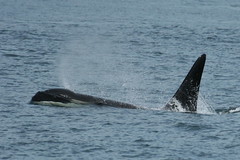
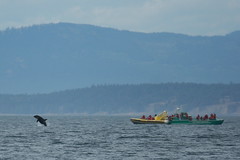
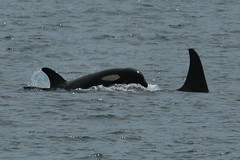
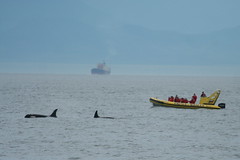
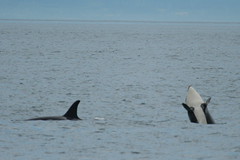
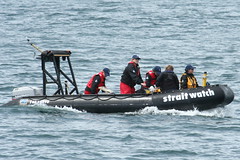
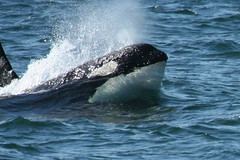
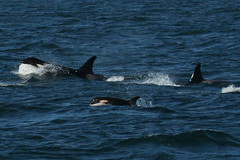
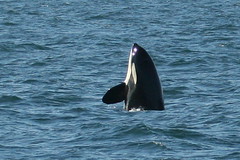
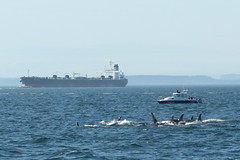
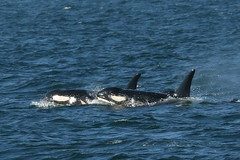
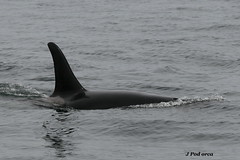
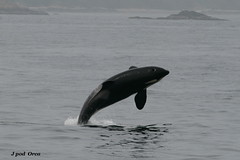
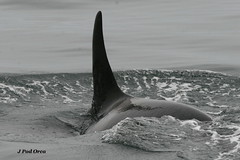
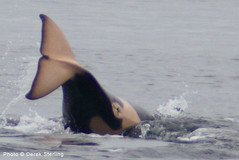
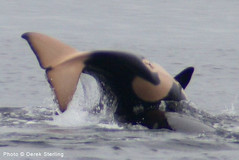
Our Ocean Magic's noon trip found us at San Juan Island (Pile Point, False Bay area) where Jpod was very spread out however were heading northbound. Got a decent look at J30 / Riptide who is sprouting this year. Most of the group was widely spread however half way through our trip, individuals turned south and west into the strait. Some hunting behavior; tail slaps and hard turns indicates the possibility of predation. We left Jpod spread out and feeding continuing to move south. Also had a chance to see Straitwatch out today, who is out monitoring the boating activity around the orcas.

IMG_6683.JPG
IMG_6689.JPG
IMG_6716.JPG
IMG_6766.JPG
IMG_6825.JPG
IMG_6857.JPG
IMG_6878.JPG

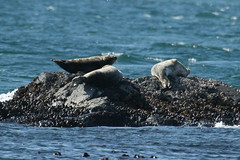
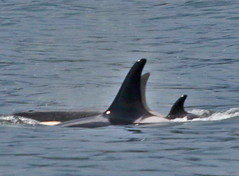
This evenings trip we headed to Race Rocks where 4 of the L12's (Calypso / L94, Matia L77), minus L12 herself were moving northeast towards San Juan Island. Mega L41 a large male was traveling alone while his other family were spread apart also. We checked out the lighthouse and found some harbour seals hauled out enjoying the afternoon in their lazy way. L12's were now founded headed past Trial Island and were in a speed porpoising behavior. We got word that Jpod were headed our direction and were in moving quickly. We found the large group of 25 all speed porpoising westbound south of Discovery Island. The group moved momentously in a group and at times a line with J1 Ruffles taking the back part of the group. New little calf J42 was seen in the middle of the family including members Riptide / J30 and assumed mom Slick / J16, where they able to help the new little arrival move under such high energy traveling.

It was absolutely spectacular to see the family travel in such a group today. I have not yet seen such a thing and my eyes could not believe the pure magic that was before me but I felt it throughout my body.

Monday, June 11, 2007

What a day!!


Saturday June 9 , Well the weather was a little ugly with lots of rain , but the whales ! In the morning we saw Jpod near San Juan Island in a tight resting formation. Later we encountered a group of 12 Transient Killer Whales hunting near Race Rocks , to top it off we had one of the first viewings of the year of L Pod. Photos by Brian Glennon, KillerWhale.ca

Tuesday, June 05, 2007

Jpod : Vancouver Run

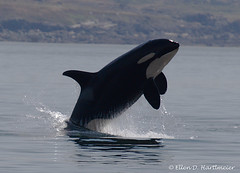
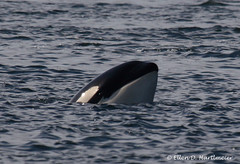
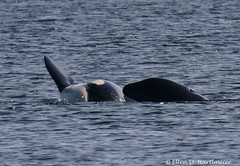
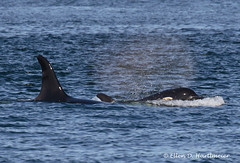
Here are some awesome captures from our Vancouver trip by naturalist Ellen;

Juvenile Breach IMG_0471
Spyhop IMG_0637
Resting and PLaying IMG_0586
Mum and Baby IMG_0600

J2 Breach

J2, known as Granny, breaching in Rosario Strait. She is the matriarch of our resident Jpod and is estimated to have been born in 1911, making her one of the oldest known killer whales in British Columbia. Our early boat was first on scene and was treated to 25 killer whales travelling south in the early morning before other boats arrived. Four generations of killer whales were present, as the 1 month old baby, J42, was also swimming among the family of whales.

photo by skipper Mark Malleson (killerwhalephotography.com)

Eagle eyes


Our late trips today had the pleasure of seeing 3 of the young orcas playing together in the kelp beds off Henry Island. We also spotted what I thought was a cormorant in the water struggling with a fish for several minutes, upon closer inspection we saw it was a bald eagle.


Photos by Brian Glennon , KillerWhale.ca

Monday, June 04, 2007

Waiting for the Cousins.


J pod continues to make us all happy by being in the area on a daily basis. Historically the rest of the Clan (K and L Pod) ,who have been away for 5 months, will make their return to the area in the coming weeks. Always very exciting. Photos by Brian Glennon , KillerWhale.ca

Friday, June 01, 2007

Jpod on the move


It was a beautiful day with the Js. Late in the day they did a quick turnaround into the flood tide after a short conference . Granny the matriarch of the pod had her faithful son by her side most of the day. Many of the pod began to porpoise through the water after the turnaround. The new calf J42 was right in the mix.

Photos by Brian Glennon , killerwhale.ca

Thursday, May 31, 2007

J41 Breach


Today our boats went the extra mile to catch up with Jpod in the Strait of Georgia. The pod was reported early this morning heading south from the mouth of the Fraser River. We were rewarded by active whales, as many of them were seen jumping repeatedly. This photograph is of J41, a 2 year old born to J19 in the summer of 2005.
photo by skipper Mark Malleson (killerwhalephotography.com)

Monday, May 28, 2007

Transients with calf


Late in the day we located J pod travelling South in Rosario Strait there was a number of unidentified whales and we realized that this was a group of transients trailing J pod, perhaps a hunting strategy? The transients later showed up in Haro Strait near Henry Island travelling north. The Male is T87. Photos by Brian Glennon , Killerwhale.ca

Friday, May 25, 2007

May 25 trip photos - Jpod

IMG_2884_1
IMG_2864_2
IMG_2819_3

Some beautiful photos taken by Ocean Magic guest Marie O'Shaughnessy

Thursday, May 17, 2007

Southern Residents , Georgia Strait


J Pod made another appearance today , they were last seem heading toward the Fraser River after cruising the Gulf Islands for the day. They seem to really love getting through Active Pass and entering the Strait , always lots of breaching and purcussive behavior. Photos by Brian Glennon

Wednesday, May 16, 2007

Evening with the J's


Few things could be better than being with J pod on a evening with glass smooth water and warm breezes. J pod was heading for Active Pass very spread out across Haro Strait. They decided to get together into a tight group prior to entering the pass. Photos by Brian Glennon , www.KillerWhale.ca

Saturday, May 12, 2007

J Pod


J Pod showed up near San Juan Island early in the day and puttered around in the area for the entire day. The new calf (J42 ) is very active and is taking long dives ( in excess of 2 minutes ) with his mother. The family was very vocal today , several times I had to turn down my hydrophone because I thought the speaker might blow !
Several rare bird sightings today as well. A tufted puffin and several brown pelicans. We seem to be getting these birds with increasing frequency . They are always a treat to see. Photos by Brian Glennon KillerWhale.ca

Thursday, May 10, 2007

T14 (Pender)


Late in the day we located the elusive transient KillerWhale T14 (pender) off Victoria. He was hunting sealions and we observed him making several charges at a sea lion , but with no apparent success.

photos Brian Glennon , KillerWhale.ca

Monday, May 07, 2007

ITS A GIRL!!!!!!!!!!

babypush2
babypush1
(click photos to enlarge)

Derek Sterling , Ocean Magic Naturalist has submitted photos to The Center for Whale Research and they have positively identified the new Jpod calf (J42 ) as a girl. Good work Derek.

Seen here is a small bit of the umbilical cord still attached. Also seen here is the activity of "baby pushing" which is meant to aid the calf in it's feeding and swimming needs. Truely a miracle of life and a gift to have witnessed, here to be shared with you!


Please read the article below for more information on this new addition to our magnificant Jpod! Sighted there is Pow's Anna Hall.

Friday, May 04, 2007

New Baby Jpod orca!

jpodbabycrop

This photo is taken by Pow's captain Brad Armstrong.

Read the Times Colonist story below. Pow's Anna Hall is interviewed also.

Front of Times Colonist

Jubiliation as a baby killer whale is born in J Pod; mother is Slick

Friday » May 4 » 2007

Jubiliation as a baby killer whale is born in J Pod; mother is Slick
First birth in pod since 2005

Judith Lavoie
Times Colonist

Friday, May 04, 2007


CREDIT: Dave Ellifrit/Center For Whale Research
Less than four days old, the newest member of a pod of endangered southern resident orcas — called J-Pod — swims with its mother off the west side of San Juan Island. The new calf, which has three siblings, is officially designated “J42,” with the sex yet to be determined.
A pink-and-black baby is causing waves of jubilation among whale watchers.

Forthe first time since 2005, an orca calf has been born to a mom in JPod, one of three pods that make up the endangered southern residentkiller-whale population.

The infant killer whale, still brightpink on the patches that will later turn white, was first spottedWednesday near San Juan Island by Anna Hall, zoologist with Prince ofWhales whale-watching tours. The birth was later confirmed by theCenter for Whale Research in Friday Harbor, Wash.

The whales appear excited about the birth, Hall said.

Oneof the baby's siblings was rolling around and slapping his tail, shesaid. "There was a lot of activity around this little calf."

Thepinky-orange colour comes from a buildup of red blood cells and isnormal for newborns, Hall said. "It will fade as the liver starts towork and will be gone in six months."

The pod had last been seenApril 28. The mother, Slick -- 35-year-old J16 in more scientificcircles -- did not have the calf with her at that time, meaning it isabout four days old, said Kelley Balcomb-Bartok, research associatewith the Center for Whale Research.

This is the fourth calf for Slick. The baby's three siblings -- Mike, Keet and Alki -- are thriving.

"The calf has a good chance of survival because J16 is a really good, attentive mother," Balcomb-Bartok said.

Althoughthe chance of survival is only 50 per cent for calves born tofirst-time orca moms, the rate increases for experienced mothers.

Thenew calf is officially designated J42, but will not be given a name forat least a year because of the high mortality rate. It is likely to beseveral years before its gender is known.

Hall, executivedirector of the Whale Watchers Operators' Association Northwest, saidthe baby killer whale should have a lower level of toxins in its bodybecause its mom had her last calf in 1999 and lactating should havecleaned some of the poisons out of her body.

No figures are available on how long killer whales lactate, but it is believed to be up to three years.

Toxins are believed to be one of the major reasons southern resident numbers are dwindling.

Althoughthis year's figures will not be finalized until L and K Pod return tothe waters off Vancouver Island, the population is believed to be about87 animals, classified as endangered by the U.S. and Canadiangovernments.

The three pods lost five members over the fall and early winter, including two breeding-age females.

J Pod, with 25 members, has produced the most calves recently and tends to stay closer to home than other pods.

"We need to think about the Ks and Ls and what is happening to them when they are not here," Hall said.

"What are they encountering that may be more of a conservation risk?"

Thetwo pods were spotted frequently off the California coast this winter,causing speculation at the Center for Whale Research that they may bemoving to California for much of the year because salmon was moreavailable than in Juan de Fuca Strait and Puget Sound.

When thepods were seen around Monterey Bay, L Pod also had a new baby.Researchers will be watching to see if it survives the trip to B.C.waters.

The whales have now disappeared from California watersand it is not known where they have gone, said Balcomb-Bartok. "Therule of thumb is they show up in early to mid-June, so we will expectthem sometime in the next month."

jlavoie@tc.canwest.com

© Times Colonist (Victoria) 2007


Copyright © 2007 CanWest Interactive, a division of CanWest MediaWorks Publications, Inc.. All rights reserved.

Tuesday, April 03, 2007