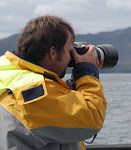
This photo is taken by Pow's captain Brad Armstrong.
Read the Times Colonist story below. Pow's Anna Hall is interviewed also.
 Jubiliation as a baby killer whale is born in J Pod; mother is Slick
Friday » May 4 » 2007
Jubiliation as a baby killer whale is born in J Pod; mother is Slick
First birth in pod since 2005
Judith Lavoie
Times Colonist
Friday, May 04, 2007
CREDIT: Dave Ellifrit/Center For Whale Research
Less than four days old, the newest member of a pod of endangered southern resident orcas — called J-Pod — swims with its mother off the west side of San Juan Island. The new calf, which has three siblings, is officially designated “J42,” with the sex yet to be determined.
A pink-and-black baby is causing waves of jubilation among whale watchers.
Forthe first time since 2005, an orca calf has been born to a mom in JPod, one of three pods that make up the endangered southern residentkiller-whale population.
The infant killer whale, still brightpink on the patches that will later turn white, was first spottedWednesday near San Juan Island by Anna Hall, zoologist with Prince ofWhales whale-watching tours. The birth was later confirmed by theCenter for Whale Research in Friday Harbor, Wash.
The whales appear excited about the birth, Hall said.
Oneof the baby's siblings was rolling around and slapping his tail, shesaid. "There was a lot of activity around this little calf."
Thepinky-orange colour comes from a buildup of red blood cells and isnormal for newborns, Hall said. "It will fade as the liver starts towork and will be gone in six months."
The pod had last been seenApril 28. The mother, Slick -- 35-year-old J16 in more scientificcircles -- did not have the calf with her at that time, meaning it isabout four days old, said Kelley Balcomb-Bartok, research associatewith the Center for Whale Research.
This is the fourth calf for Slick. The baby's three siblings -- Mike, Keet and Alki -- are thriving.
"The calf has a good chance of survival because J16 is a really good, attentive mother," Balcomb-Bartok said.
Althoughthe chance of survival is only 50 per cent for calves born tofirst-time orca moms, the rate increases for experienced mothers.
Thenew calf is officially designated J42, but will not be given a name forat least a year because of the high mortality rate. It is likely to beseveral years before its gender is known.
Hall, executivedirector of the Whale Watchers Operators' Association Northwest, saidthe baby killer whale should have a lower level of toxins in its bodybecause its mom had her last calf in 1999 and lactating should havecleaned some of the poisons out of her body.
No figures are available on how long killer whales lactate, but it is believed to be up to three years.
Toxins are believed to be one of the major reasons southern resident numbers are dwindling.
Althoughthis year's figures will not be finalized until L and K Pod return tothe waters off Vancouver Island, the population is believed to be about87 animals, classified as endangered by the U.S. and Canadiangovernments.
The three pods lost five members over the fall and early winter, including two breeding-age females.
J Pod, with 25 members, has produced the most calves recently and tends to stay closer to home than other pods.
"We need to think about the Ks and Ls and what is happening to them when they are not here," Hall said.
"What are they encountering that may be more of a conservation risk?"
Thetwo pods were spotted frequently off the California coast this winter,causing speculation at the Center for Whale Research that they may bemoving to California for much of the year because salmon was moreavailable than in Juan de Fuca Strait and Puget Sound.
When thepods were seen around Monterey Bay, L Pod also had a new baby.Researchers will be watching to see if it survives the trip to B.C.waters.
The whales have now disappeared from California watersand it is not known where they have gone, said Balcomb-Bartok. "Therule of thumb is they show up in early to mid-June, so we will expectthem sometime in the next month."
jlavoie@tc.canwest.com
© Times Colonist (Victoria) 2007
Copyright © 2007 CanWest Interactive, a division of CanWest MediaWorks Publications, Inc.. All rights reserved.


 J2, known as Granny, breaching in Rosario Strait. She is the matriarch of our resident Jpod and is estimated to have been born in 1911, making her one of the oldest known killer whales in British Columbia. Our early boat was first on scene and was treated to 25 killer whales travelling south in the early morning before other boats arrived. Four generations of killer whales were present, as the 1 month old baby, J42, was also swimming among the family of whales.